Showing posts with label Book review. Show all posts

Friday, 1 May 2015

Review: 'The Art and Craft of Storytelling' by Nancy Lamb

The Art and Craft of Storytelling: A Comprehensive Guide to Classic Writing Techniques by Nancy Lamb, 2008, Writer's Digest Books, $16.99, softbound, 264 pages. Cover: good. Category/Genre: Reference; Writing How-to. Where we got it: bought it. Where you can get it: Amazon, Barnes and Noble, Books-A-Million. 


From the three approaches to storytelling to the fundamentals of endings, this is a book chock-full of lists about writing. Lamb goes over ways to structure your story, strategies for creating your opening paragraph, types of conflict, point of view, voice and tone, setting, and much more. She also defines a number of genres and categories within those genres, then supplies a list of books to read, all of which are listed by genre. 

Lamb does have a tendency to repeat herself; the book is perhaps a third to a half comprised of repetition. But if this doesn't annoy you (or if you simply need that much repetition to absorb new information), you might want to try this book. Lamb makes a lot of good points, and even seasoned pros might do well to review some of her ideas. 


If you like this one, try: On Writing, by Stephen King. 


You can find Nancy Lamb at nancylamb.com, Twitter, and Goodreads. 

Friday, 13 February 2015

Review: 'Historical Heartthrobs' by Kelly Murphy with Hallie Fryd

Historical Heartthrobs: 50 Timeless Crushes – from Cleopatra to Camus by Kelly Murphy with Hallie Fryd, $17.99, hardbound, 223 pages. Cover: pretty good. Category/Genre: Reference. Where we got it: publisher. Where you can get it: Amazon, Barnes and Noble, Books-A-Million.


From artists to rulers to scientists and civil rights activists, this book offers a glimpse at what made people fall for certain celebrities of the day – and whether or not we would find them just as appealing today.

It isn't just physical attributes that are measured here. Charisma goes a long way, as does intellect, bravery, and wit. Factors that may dampen the sex appeal of those found in this book include narcissism, rudeness, and homicidal tendencies.

You'll find a whole host of hotties to choose from: Cleopatra, Annie Oakley, Jane Goodall, Jim Thorpe, and Frederick Douglass to start; and not all of them were good guys. You'll find Mata Hari, John Wilkes Booth, and Bugsy Siegel in these pages, as well.

Vital stats are given: date of birth and death; country of origin; area of influence; and style of seduction. There are quotes about each celebrity, as well as a brief life story, information on his or her sex life, and a blurb on why that person matters today. The “Heat Factor” is measured from one to five (five being the hottest). There are also pictures (photographs or portraits) of each of the hotties.

An unusual, interesting way to learn a bit of history.


If you like this one, try: Suggestions? 


Friday, 6 February 2015

Review: 'Nightmares Can Be Murder' by Mary Kennedy

Nightmares Can Be Murder by Mary Kennedy, 2014, Berkley Prime Crime, $7.99, softbound, 292 pages. Cover: like it. Category/Genre: cosy mystery. Where we got it: publisher. Where you can get it: Amazon, Barnes and Noble, Books-A-Million.


Freelance business consultant Taylor Blake is in Savannah to help her sister Ali cope with her struggling business. What she doesn't expect is that Ali will rope her into attending the Dream Club, a group of women dedicated to helping each other analyse their dreams.

She also doesn't expect to become embroiled in a murder; but that's exactly what happens when a local dance instructor and ladies' man is killed in his studio. Ali becomes a suspect, and Taylor is determined to solve the case and clear her sister's name.

To do this, she enlists the help of an old friend, Sara Rutledge, a freelance reporter for the local paper, and Taylor's ex, Noah Chandler, a former FBI agent-turned-private enquiry agent. But Taylor isn't over Noah, and she's unclear as to how he feels about her.

We had a couple of issues with this book: there are too many women in it; it's unrealistic. Plus we take great umbrage at the use of 'womans's' – which anyone interested in grammar can tell you is incorrect. Still, it was an enjoyable read, and we recommend it.

This is an unusual mystery, not only for the matter of the dream interpretations, but also because, refreshingly, it doesn't tend to follow the usual formula for cosy mysteries.

If you like this one, try: The Missing Ink, by Karen E Olson.


Friday, 30 January 2015

Review: 'Cold Press Juice Bible' by Lisa Sussman

Cold Press Juice Bible: 300 Delicious, Nutritious, All-Natural Recipes for Your Masticating Juicer by Lisa Sussman, 2014, Ulysses Press, $14.95, softbound, 192 pages. Cover: colourful. Genre: cookbook. Where we got it: publisher. Where you can get it: Amazon, Barnes and Noble, Books-A-Million.


This is a cookery book, but it also has loads of information on why and how one should juice. There are lots of useful tips on buying a juicer, as well.

The ideal four parts vegetable, one part fruit ratio of your juices may be unpalatable at first, so Sussman suggests counteracting the strong flavour with lemon, salt, carrots, ginger, apples, or cucumbers (among other things). She has a section on how to mesh flavours, too. And you might want to add watery fruits and veg or a splash of liquid to prevent your juice looking and tasting like so much green sludge.

Sussman also has a section dedicated to keeping your juice safe (some veg can be eaten raw, but some need to be cooked first).

The recipes are divided into seven 'mealtimes,' and there are four categories of juices (green, root vegetable, fruit, and milky juices). Each recipe lists the ingredients and three other ways to try it. For example, 'Peanut Butter Cup' is made with spinach, chia seeds, chocolate protein powder, peanut butter, and honey – but you can make it rooty by adding a sweet potato; or milky by adding banilla-infused almond milk; or fruity by adding fresh cherries.


If you like this one, try: The Green Teen Cookbook, edited by Laurane Marchive and Pam McElroy.

Friday, 23 January 2015

Review: 'A Grave Matter' by Anna Lee Huber

A Grave Matter by Anna Lee Huber, 2014, Berkley Prime Crime, $16.00, softbound, 421 pages. Cover: excellent. But we thought she was supposed to have dark hair. Category/Genre: historical mystery. Where we got it: publisher. Where you can get it: Amazon, Barnes and Noble, Books-A-Million.


The third in the Lady Darby mysteries, this book takes place two months after the events of the previous book. Lady Kiera Darby is still reeling from the loss of a dear friend and finds herself attending – rather unwillingly – the annual Hogmany Ball with her older brother, Trevor.

The festivities are ended when news of a murder comes: the family caretaker, Dodd, was shot and killed, and a body is missing from the family plot at the abby. Because the town doctor is inebriated, Kiera – who has experience with dead bodies and investigations – is asked to view Dodd's body and shed whatever light she can.

She is also soon asked to contact Sebastian Gage, a gentleman investigator, and ask that he come to solve the mystery and retrieve the missing bones. Kiera agrees to this somewhat reluctantly; she and Gage have a past, and she's still not certain of her feelings on the matter – or of his feelings for her, for that matter.

Nonetheless, the investigation and Gage's company combine to draw her out of her dark mood. Soon she is painting again, a talent which has of late eluded her. And sooner than she expects, she has an answer to how Gage feels about her.

The mystery of the body snatching, however, is not so easy. Though the team gather clues, nothing seems to lead them anywhere. Could it be that these body snatchers are just too clever to be caught?

Once again, Anna Lee Huber has woven together an intriguing plot and Scottish history and culture.

Note: mild language.


If you like this one, try: The Anatomist's Wife, by Anna Lee Huber; Mortal Arts, by Anna Lee Huber; Some Danger Involved, by Will Thomas. 

Friday, 16 January 2015

Review: 'The Hollow Hills' by Mary Stewart

The Hollow Hills by Mary Stewart, 1973, Eos, $15.99, softbound, 475 pages. Cover: good, but Arthur looks a bit too much like a model. Category/genre: fantasy. Where we got it: publisher. Where you can get it: Amazon, Barnes and Noble, Books-A-Million. 


This, the second installment in Stewart's Arthurian saga, takes place the morning after the events in The Crystal Cave. Merlin returns to his cave and discovers his magic is gone. But he is still needed in Arthur's life even this early on: the queen, Ygraine, wants Merlin to take the child and raise him once he is born. 

But it's decided that until the boy is weaned, he will be cared for by Moravik, Merlin's old nurse, and Ralf, Merlin's assistant. Then he will be raised in secret by Count Ector, a friend of the king. Merlin will meet Arthur when it is time. 

When it's time for Arthur to come into his own, Merlin will have to face an old enemy and see that Arthur is declared king before it's too late. 

Stewart's imagining of the Arthurian legend is one of the best you'll ever come across. Her historical accuracy and rich characters, coupled with a rather mundane take on Merlin's skills as a magician make this an unusual read. 

If you like this one, try: The Last Enchantment, by Mary Stewart. 

Friday, 9 January 2015

Review: '7G' by Debbie Kump

7G, by Debbie Kump, 2011, World Castle Publishing, $10.99, softbound, 244 pages. Category/Genre: science fiction. Cover: good but not great; the woman's expression is kind of irritating. Where we got it: the author's cousin. Where you can get it: Amazon, Barnes and Noble, Books-A-Million. 


The premise of 7G is technology gone awry. Very awry. Everyone wears DOTS -- Digital Optic/Opthalmic Transmitters -- which are like contact lenses and ear pieces, and which connect them to everything and everyone all the time. Soon 7G will be here, and it will upgrade DOTS to a previously unimagined level. 

There are several characters in the book, but the main two are Alyssa Kensington and Erik Weber. Alyssa is a seaman apprentice aboard a submarine in the Navy, and Eric is a student at Southern Florida State University. Both have tumultuous love lives: Alyssa is in love with an officer, which is prohibited in the Navy, and Erik has just seen his girlfriend with another guy. 

Also on Alyssa's plate is the fact that she suspects the secret sonar tests the sub has been conducting have had a detrimental effect on local marine life. Her concerns are overlooked by her superior, and the officer she's been seeing doesn't even stick up for her. 

Then 7G arrives and changes everything. People and animals are dead, and it's up to the survivors to pick up the pieces of a dystopian world. 

This was a good book, overall. There were some grammatical errors, but the main problem was that most of the story was about the anticipation of 7G, rather than what happened after it arrived. We would have preferred it if there was more to the ending. 

Note: mild language. 

If you like this one, try: Suggestions? 

Friday, 2 January 2015

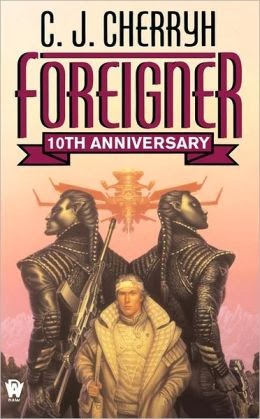
Review: 'Foreigner' by C.J. Cherryh

Foreigner by C.J. Cherryh, 1994, DAW, $7.99, softbound, 428 pages. Category/Genre: science fiction. Cover: brilliant. Where we got it: prezzie. Where you can get it: Amazon, Barnes and Noble, Books-A-Million.


The first in a long-running series about Bren Cameron, a human translator on an alien world, Foreigner hits the ground running. It begins with an assassination attempt on Bren, and only gets more interesting from there as Bren is shuffled off to a remote and quite ancient dwelling where no human has ever set foot. 

In this book, we are introduced to several key characters who will return again and again throughout the series, among them Tabini, Bren's superiour and the leader of the Western Association of the atevi; Banichi and Jago, Bren and Tabini's security (read: trained assassins); and wily Ilisidi, Tabini's grandmother. 

The action is paralleled by rich characterisation and a well-developed alien culture and world. Few writers can create the vivid sorts of universes C.J. Cherryh is capable of creating, and her work truly shines in this novel. The angle of seeing the atevi through the eyes of the only human allowed on that side of the strait is a clever one, and added to that is the unusual job Bren has as translator between the atevi and the human population on the island of Mospheira. 

Note: mild language. 

If you like this one, try: Invader, by C.J. Cherryh; The Chanur Saga, by C.J. Cherryh; and Downbelow Station, by C.J. Cherryh. 

Friday, 26 December 2014

Review: 'Kwanzaa: An African-American Celebration of Culture and Cooking' by Eric V Copage

Kwanzaa: An African-American Celebration of Culture and Cooking by Eric V. Copage, 1991, William Morrow and Company, $25.00, hardbound, 356 pages. Cover: nice. Category/Genre: cookbook. Where we got it: borrowed it. Where you can get it: Amazon, Barnes and Noble. 


This book is a cookery book, but it's also an introduction to the cultural holiday of Kwanzaa. If you're interested in celebrating, you may like to know that Kwanzaa doesn't take the place of Christmas; it falls from December 26 – New Year's Day, so you can celebrate both if you want.

In case you don't know anything about this holiday, this book offers a bit of history along with a guide to help you celebrate Kwanzaa the way its creator first conceived it. How you celebrate is strictly up to you, however, and there are some other ideas included on how to personalise your Kwanzaa celebration.

If you're already familiar with Kwanzaa, you still might find this book useful, as there are over 125 recipes from people of African descent from all across the globe in it. Even if you've been celebrating for years, you're likely to discover some new recipes here.

Next each recipe is the recipe's country of origin and a bit about the person who contributed the recipe. You'll find appetizers, soups, salads, main dishes, side dishes, vegetables, breads, beverages, and desserts. Plus there's an index of mail-order sources and a list of suggested menus.

Countries included are: Kenya, South Africa, Antigua, Barbuda, and the United States (with heavy emphasis on the US).

Recipes include: 'Spicy Matoke: Beef and Plantain “Cake”' from Kenya; 'Antigua Fruit Salad with Lime-Nutmeg Dressing' from Antigua and Barbuda; 'Conkies: Individual Cornmeal and Raisin Puddings in Banana Leaves' from Barbados; and 'Mavis's Pineapple-Papaya Punch' from the US.


If you like this one, try: Suggestions? 

Friday, 19 December 2014

Review: 'The Litter of the Law' by Rita Mae Brown and Sneaky Pie Brown

The Litter of the Law by Rita Mae Brown and Sneaky Pie Brown, Illustrated by Michael Gellatly, 2013, Bantam, $7.99, softbound, 292 pages. Category/Genre: mystery. Cover: very nice. Where we got it: publisher. Where you can get it: Amazon, Barnes and Noble, Books-A-Million.


This series is a bit unusual in that a cat named Sneaky Pie Brown helped write it. Perhaps because of that, there are a good deal of animal characters (one of whom reportedly looks astonishingly like Sneaky Pie Brown), all of whom can talk to each other but who are not understood by humans. The animals' antics are surely one reason this series is so popular – it's a New York Times bestseller – but the human characters are also interesting, and the mystery is intriguing.
Mary Minor 'Harry' Haristeen and her husband, Fair, have a farm and a number of animals – not the least of whom are Mrs Murphy, the grey tiger cat; Tee Tucker, a corgi; and Pewter, a grey cat who loves eating more than just about anything else in the world. It's these three animals who do the most to help Harry when she's trying to solve a mystery, although they also enlist help from the other animals: crows, a possum, horses, a fox, and others.

In this installment, Harry, Fair, and their brood come across a scarecrow – a familiar sight in farmland, especially in October – but what isn't familiar is the attention the scarecrow is getting from the local crows, who are pecking at the scarecrow as if it's some sort of delicacy. Which, it turns out, it is, at least to crows. The scarecrow is actually a murder victim dressed up.

This grisly discovery is only the start; as Harry digs deeper, she uncovers an insidious plot that she and the other inhabitants of Crozet find both horrifying and enraging. But it's only a matter of time before the perpetrator realises Harry is getting too close and decides to cut his losses . . .

A good, quick read, The Litter of the Law will no doubt satisfy both those new to the series and those who are steadfast followers of Mrs Murphy and her gang of animal sleuths. If it were up to us, though, we'd opt for a bit less of the talk of crops and more from the animals' points of view. All in all, well done, and there's a handy reference guide at the beginning so you won't get lost amongst all the characters.


If you like this one, try: Wish You Were Here, by Rita Mae Brown and Sneaky Pie Brown; and The Cat Who . . . books by Lilian Jackson Braun. 


Friday, 12 December 2014

Review: 'The Wreath Book' by Rob Pulleyn

The Wreath Book by Rob Pulleyn, 1988, Sterling/Lark, hardbound, 144 pages. Cover: not bad. Category/Genre: how-to. Where we got it: borrowed it. Where you can get it: Amazon, Barnes and Noble. 


This book, filled with colour photographs, gives you all the information you need to make the over 100 wreaths in the book, plus any of your own invention. Handy tools are listed, and you're told how to make a base and attach materials. It does take a few hours to learn, so be prepared.

These wreaths are for the holidays, but they're also for any other time of the year, and for every room in the house.

Among the different types of wreath highlighted are 'collection wreaths' for teen rooms; culinary wreaths for the kitchen; quilted and appliqued wreaths for a sewing room; edible wreaths for a party table; and a moth-repelling wreath for a closet door. Plus there are 'Childhood Memento' wreaths for using discarded toys and 'Wearable Wreaths' for brides, hats, and jackets.

The 'Scented Wreaths' use items such as potpourri, cinnamon sticks, and fraser fir; the 'Herbal Wreaths' use elements that are often insect-repellent or fragrant; and there's a shell wreath, as well. Pulleyn also suggests putting a wreath on a table as a centrepiece.

In addition to all the wreaths, you'll learn how to make and use bows; cleaning and preserving techniques; and how to make a wreath with meaning (Pulleyn lists common plant and flower meanings, both secular and religious).

A lot of the projects look like fun, and wreaths can be made as gifts, too.


If you like this one, try: Suggestions?  

Friday, 28 November 2014

Review: "World-Building" by Steve Gillett

World-Building: A Writer's Guide to Constructing Star Systems and Life-Supporting Planets by Steve Gillett, 1996, Writer's Digest Books, $16.99, hardbound, 198 pages. Category/Genre: writing reference. Cover: atmospheric and appropriate. Where we got it: bought it. Where you can get it: Amazon, Barnes and Noble.


The purpose of this book is to help you create a sense of wonder in your speculative fiction by using real science. Gillett begins by delving into the astronomical, such as variables (like season change and tidal action) that affect planets, and some of the differences between stars and planets. He also helps the reader understand and calculate astronomical scales. He goes into the details of creating a planet, and here provides some variations, as well. He also takes a look at the Earth and some possible variations, and here he includes information on a planet's colors, the atmosphere, the ocean, plate tectonics, and more. 

In addition, Gillett discusses Earth's earlier days, other planets, suns and stars, and more exotic possibilities for the planets you create. Also in the book are references and a resources guide.

An interesting book. If you want to write science fiction set on different planets, World-Building is a great way to get you started. 

If you like this one, try: How to Write Science Fiction and Fantasy by Orson Scott Card, The Writer's Guide to Creating a Science Fiction Universe by George Ochoa and Jeffrey Osier, Space Travel: A Writer's Guide to the Science of Interplanetary and Interstellar Travel by Ben Bova with Anthony R. Lewis, and Aliens and Alien Societies by Stanley Schmidt. 

Friday, 21 November 2014

Review: "Aliens and Alien Societies" by Stanley Schmidt

Aliens and Alien Societies by Stanley Schmidt, 1995, Writer's Digest Books, $17.99, hardbound, 226 pages. Category/Genre: writing reference. Cover: evocative. Nice artwork. Makes you want to open the book. Where we got it: bought it. Where you can get it: Amazon.


This book covers just about everything you might want to know about creating aliens and alien societies. It starts with a couple of basic questions (what are aliens, and why would you want to write about them?), then moves on to achieving plausibility in your writing. Astronomical and biochemical essentials are explored, as well as the importance of making your aliens fit their environments, creating alien cultures and languages, and how aliens might interact with humans. 

Schmidt also goes into alien motivations, and gives some samples for the reader to study. He closes the book with a discussion of more exotic possibilities before giving an extensive list of references and a glossary. Schmidt peppers the text with examples from both his own and others' writing, and whets the reader's interest for more. If you want to write about aliens, you'll want this on your bookshelf. 

If you like this one, try: How to Write Science Fiction and Fantasy by Orson Scott Card, World-Building: A Writer's Guide to Constructing  Star Systems and Life-Supporting Planets by Steve Gillett, The Writer's Guide to Creating a Science Fiction Universe by George Ochoa and Jeffrey Osier, and Space Travel: A Writer's Guide to the Science of Interplanetary and Interstellar Travel by Ben Bova with Anthony R. Lewis.

Friday, 14 November 2014

Review: 'Let Them Eat Stake' by Sarah Zettel

Let Them Eat Stake, by Sarah Zettel, 2012, Obsidian, $7.99, softbound, 308 pages. Category/Genre: mystery/paranormal. Cover: quirky. Where we got it: publisher. Where you can get it: Amazon, Barnes and Noble, Books-A-Million.


This is the second in a series about chef Charlotte Caine and her Manhattan restaurant, Nightlife. Charlotte caters to both 'daybloods' (humans) and 'nightbloods' (vampires); human herself, she's dating Brendan Maddox, a warlock, and is binterested in vampire Anatole Sevarin. 

But Charlotte's love life isn't the only thing that's complicated. She's catering the first witch/vampire wedding she's ever heard of, and her executive chef, Oscar, is not only refusing to work for the wedding, he won't let any of his staff work for the wedding, either. 

Then Oscar is discovered dead. Charlotte takes it upon herself to find out who's responsible, and puts herself in harm's way in the process. One thing she is sure of: the possession of a certain powerful artifact may be at the heart of what's going on. 

This is a good book, and we look forward to trying the rest of the series. There's some humour, and the characters are interesting; what's more, the combination of vampires and chefs is an unusual pairing for a mystery. 

If you like this one, try: A Taste of the Nightlife, by Sarah Zettel.  

Friday, 7 November 2014

Review: 'The Iron King' by Julie Kagawa

The Iron King, by Julie Kagawa, 2010, Harlequin Teen, $9.99, softbound, 363 pages. Category/Genre: fantasy. Cover: cool. Where we got it: publisher. Where you can get it: Amazon, Barnes and Noble, Books-A-Million. 


This book is the first in a series about a teenage girl named Meghan Chase, whose four-and-a-half year old brother, Ethan, is kidnapped by the fey and replaced with a changeling. Meghan, along with her best friend, Robbie (who is not what he seems) sets out to find her lost brother, travelling to Faeryland, also known as Nevernever. 

Along the way, Meghan travels through the treacherous Wyldwood, which is disappearing due to human disbelief. She also meets Grimalkin, a Cait Sidhe who comes to her aid in return for an unnamed favour. It is dangerous, Meghan learns, to owe the fey anything . . . 

There are two Courts of fey: the Seelie and Unseelie; the Seelie are the Summer Court and are ruled by King Oberon and Queen Titania. The Unseelie are the Winter Court and are ruled by Queen Mab. Mab's youngest son, Ash, has hunted Meghan, but the two of them are attracted to each other. 

Then Meghan discovers there's a third Court of fey, the Iron Fey, and things really start to get interesting . . . 

This promises to be a good series, and the idea of the Iron Fey is intriguing and unusual, bringing the world of Faery into the modern age. 

Note: strong language.

If you like this one, try: The Iron Daughter, by Julie Kagawa. 


Friday, 31 October 2014

Review: 'Discount Armageddon' by Seanan McGuire

Discount Armageddon, by Seanan McGuire, 2012, DAW, $7.99, softbound, 352 pages. Category/Genre: fantasy. Cover: sexy. Where we got it: publisher. Where you can get it: Amazon, Barnes and Noble, Books-A-Million. 


The first in a new series by the author who gave us the October Daye novels, Discount Armageddon is a new take on the urban fantasy. 

Verity Price is part of a family of cryptozoologists -- people who study, and protect humanity from, creatures whose existence has yet to be proven by science: 'monsters' such as yeti and dragons (although dragons are said to be extinct). 

Verity has a job waitressing at Dave's Fish and Strips to pay the rent -- but she really wants to be a ballroom dancer. Officially, she's in New York to document and assist the city's cryptid community. And she's doing fine at that -- until another cryptozoologist shows up. His name is Dominic DeLuca, and he's part of The Covenant, a group who believe that all cryptids should be destroyed. Verity's family broke from The Covenant generations ago and have been in hiding from them ever since. 

Then someone starts killing cryptids -- and it isn't Dominic. Add to that the fact that there may be a dragon under the city, and you have a recipe for disaster . . . especially as Verity and Dominic start to fall for each other. 

Apart from the cool fight scenes in this book, there's a lot of information on the various cryptids Verity meets, as well as a lot of humour. Particularly where the Aeslin mice are concerned. There's a group of them living in Verity's apartment, and they thrive on rituals and shouting 'Hail!' at every opportunity.

Note: strong language and sexual situations. 

If you like this one, try: Midnight Blue-Light Special, by Seanan McGuire; and the October Daye series, starting with Rosemary and Rue, also by Seanan McGuire.  

Thursday, 23 October 2014

Review: 'Murphy: Gold Rush Dog' by Alison Hart

Murphy: Gold Rush Dog by Alison Hart, Illustrated by Michael G Montgomery, 2014, Peachtree, $12.95, hardbound, 176 pages. Category/Genre: historical fiction. Cover: excellent. Where we got it: publisher. Where you can get it: Amazon, Barnes and Noble, Books-A-Million. 


The second installment in the Dog Chronicles, Murphy takes us to Nome, Alaska, 1900, where abused sled dog Murphy escapes his cruel master, Carlick. All Murphy wants is a home, and maybe bacon. 

Then Murphy finds Sally and her mother, who are just arriving in Alaska. Murphy instinctively befriends the pair, and the trio become a family. 

But life in Alaska is hard; while Sally delivers mail to earn enough to stake a claim, Mama struggles to provide for the family by typing in an office. The family has no house, only a tent on the beach -- but when the snows come, they will need a house, or they will have to leave Alaska. 

Desperate to stay in Alaska, Sally takes Murphy and goes to stake a claim, facing deadly predators and storms. If she can only find enough gold to buy a house, the family can stay. But Carlick and the claim jumper he works for have other plans . . . 

This is an exciting book with history woven in, all told from a dog's point of view. More history is included in the back of the book, as well as a list of books for further reading. The black and white illustrations add further interest and are a pleasure to look at. 

For ages seven to 10. 

If you like this one, try: Darling, Mercy Dog of World War I, by Alison Hart. 

Don't forget the other stops on the tour:

Today: The 4th Musketeer

Friday: Sally's Bookshelf .

Friday, 17 October 2014

Review: 'A Local Habitation' by Seanan McGuire

A Local Habitation, by Seanan McGuire, 2010, DAW, $7.99, softbound, 387 pages. Category/Genre: fantasy. Cover: atmospheric. Where we got it: publisher. Where you can get it: Amazon, Barnes and Noble, Books-A-Million. 


The second in the October Daye series, A Local Habitation finds October 'Toby' Daye on what she considers a milk run: going to Tamed Lightning (a fae County) to find out why her liege's niece, January, isn't returning his calls. Toby takes with her Quentin, a page, so he can learn from her. 

But the pair soon find out that the 'milk run' isn't as simple -- or as harmless -- as all that. There's a murder at Tamed Lightning soon after they arrive, and it isn't the first. 

No-one's talking, however. It takes some time for Toby to even find January, and even she acts like she's hiding something. To complicate matters still further, January doesn't trust Toby to be who she says she is. Her phone calls to her uncle, she says, have never been returned. 

Still more unsettling is the fact that neither Toby nor Quentin are able to read the dead's blood; as Daoine Sidhe, they should be able to gather memories from it by tasting it, but they get nothing. And the night-haunts, who normally take away the bodies of dead fae, aren't taking these. 

This is a good mystery with fascinating characters and McGuire's fluid storytelling. The fae in this series are based on real legends, but have McGuire's stamp all over them. 

If you like this one, try: Rosemary and Rue, by Seanan McGuire; Midnight Blue-Light Special, by Seanan McGuire; and for young adults, The Iron King, by Julie Kagawa -- this one's less urban fantasy, but the fae are well drawn, and there's an interesting twist to the story.      

Thursday, 9 October 2014

Review: 'Can I Come, Too?' by Brian Patten

Can I Come, Too? by Brian Patten, Illustrated by Nicola Bayley, 2014, Peachtree, $16.95, hardbound, 29 pages. Cover: very good. Where we got it: publisher. Where you can get it: Amazon, Barnes and Noble, Books-A-Million. 


One day, a little mouse decides to have a big adventure: she wants to see the biggest creature in the world. 

First she finds a frog -- he isn't the biggest creature, but he wants to see who is. So he comes along. Then they add a kingfisher to their party. And on it goes, with bigger and bigger animals joining the group, until finally they go to where the river ends and find the one who is truly the biggest creature in all the world. 

A well-told story, this book has artwork that's as descriptive as the text. The animals' expressions and the way they seem to move across the page bring them to life. Children and adults alike will enjoy reading Can I Come, Too?, and every kid will wonder up until the end who the biggest animal is.

If you like this one, try: Suggestions?   

Friday, 3 October 2014

Review: 'The Wild Ways' by Tanya Huff

The Wild Ways, by Tanya Huff, 2011, DAW, $7.99, softbound, 424 pages. Category/Genre: fantasy. Cover: interesting, but not spectacular. Where we got it: publisher. Where you can get it: Amazon, Barnes and Noble, Books-A-Million.


Charlie Gale is part of the Gale family, those who can alter reality with the charms they weave. Charlie is a rare Wild Power, the extent of whose powers are as yet unrealised. She's wild in other ways, too; she has sex with her married cousin, Allie, and travels between worlds. 

When Charlie finds out a selkie rookery is endangered, she sets out to help, with the aid of Jack, a 14-year-old Dragon Prince who's finding it hard to be a normal teenage boy. But helping the selkies isn't going to be easy; Charlie's Auntie Catherine, another Wild Power, is against them. 

The second in a series, The Wild Ways can be enjoyed without having read the first book -- but we wouldn't recommend it. Huff doesn't explain certain things, at least not to our satisfaction, and one would hope she explains them more fully in the first installment, The Enchantment Emporium. Still, this proved an entertaining read, and you might do well to pick up the first one just to have more of Huff's writing to read. 

One thing we liked about this book in particular was the use of selkies as a focal point in the plot; selkies are seldom, if ever, used in modern fiction, and Huff's take on them suits the old legends. 

Note: strong language.

If you like this one, try: The Enchantment Emporium by Tanya Huff.