Britain's Day-Flying Moths: A Field Guide to the Day-Flying Moths of Britain and Ireland by David Newland, Robert Still, and Andy Swash, 2013, Princeton University Press, $19.62, softbound, 224 pages. Category/Genre: reference. Cover: beautiful. Where we got it: publisher. Where you can get it: Amazon, Barnes and Noble, Books-A-Million.
This book goes over lots of interesting information about moths, such as the difference between butterflies and moths, what a day-flying moth is, moth biology, the naming of moths, and where to look for day-flying moths. There's also a nice section on gardening for moths: what food plants are good to have in your garden in order to attract specific species, and tips such as the fact that ' "old-fashioned" varieties of plants are often better for moths than modern cultivars because their nectar is more easily extracted.'
Then come the species accounts, in which you will find a detailed description of families and species, whether or not the species in question is scarce or widespread, where it is found, when it flies, forewing length, larval food plants, and similar species. Close-up colour photographs accompany each species account.
There's also information on conservation and legislation.
If you like this one, try: Peterson Field Guide to Moths of Northeastern America, by David Beadle and Seabrooke Leckie.
 Mammals of Britain and Europe by FH Van Den Brink, Translated and Edited by Hans Kruuk and HN Southern, Illustrated by Paul Barruel, 1986, The Easton Press, $17.94, hardbound, 221 pages. Category/Genre: reference. Cover: elegant. Where we got it: bought it. Where you can get it: Amazon, Barnes and Noble.
This guide showcases 177 species, some of whom are quite rare. Some species who are extinct in the wild have also been included, either because some specimens still exist in captivity, or because domesticated races are being bred to recreate the species, or because the species still exist elsewhere, and it is desirable that they be reintroduced.
Barruel's handsome illustrations accompany the text and help the reader in identifying the many species included. The guide is divided into ten main parts: Insectivores; Bats; Apes; Rabbits, Hares, and Pikas; Rodents; Carnivores; Odd-Toed Ungulates (Horses); Even-Toed Ungulates (Pigs, Deer, and Bovines); Toothed Whales; and Baleen or Whale-Bone Whales. There are 20 coloured plates and 12 black- and-white plates.
A brief description is given on each Order, and then details are listed for each species, including measurements, physical description, habitat, range, habits, and similar species. There are maps, notes on how to take measurements, a word on the study and protection of mammals, and an explanation of the symbols used in the book.
Also included are taxonomic notes and dental formulae.
If you like this one, try: Mammals of Britain and Europe (Collins Field Guide), by David McDonald and Priscilla Barrett.
The Crossley ID Guide: Raptors, by Richard Crossley, Jerry Liguori, and Brian Sullivan, 2013, Princeton University Press, $29.95, softbound, 285 pages. Category/Genre: reference. Cover: interesting. Where we got it: publisher. Where you can get it: Amazon, Barnes and Noble, Books-A-Million.
This book starts out with a look at raptors in flight, then moves on to 'raptor topography,' which is the tracts of feathers and the anatomy of birds. This part is fascinating for anyone interested in the science of birds, and -- like the rest of the book -- is illustrated with clear colour photographs. If you don't know already, some of the things you will learn here are that the colour of the iris often changes with age, the nape is the back of the neck, and the uppertail coverts are the rump.
After that are species accounts, and then mystery photo images. These are pictures of various raptors who the authors encourage you to identify and age; the answers are included later in the book. The species accounts include range maps, an overview, comments on flight style, the size and shape of the bird, plumage, and more.
A terrific book for anyone interested in raptors.
If you like this one, try: Hawks of North America, by William S. Clark and Brian K. Wheeler.
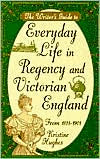 The Writer's Guide to Everyday Life in Regency and Victorian England from 1811-1901, by Kristine Hughes, 1998, Writer's Digest Books, $18.99, softbound, 248 pages. Category/Genre: reference. Cover: interesting, though the colours are a bit lacking. Where we got it: bought it. Where you can get it: Amazon, Barnes and Noble, Books-A-Million.
A must-have for any writer looking for a reference book on England in this time period. The book is quite thorough; Part One, 'Everyday Life,' examines such topics as lighting, heating, and plumbing, home furnishings, domestic servants, and fashion.
Part Two, 'Government, War, and the Economy,' goes over the courts, the military, economics, banking, and the labouring classes.
Part Three, 'Society,' deals with shopping, etiquette, travel, mourning, and more.
There are a few black-and-white pieces of artwork and a number of bibliographies. In this book, you will find interesting tidbits, such as a list of major London newspapers in circulation from 1837-1850. Details such as this can really help a book along, and if you decide to write about characters during this time period, this book will surely be an asset.
If you like this one, try: The Writer's Guide to Everyday Life in the Wild West from 1840-1900, by Candy Moulton.
Collins Complete Guide to British Garden Wildlife by Paul Sterry, 2010, Collins, $22.14, softbound, 383 pages. Category/Genre: reference. Cover: excellent. Where we got it: bought it. Where you can get it: Amazon, Barnes and Noble.
A wonderful book in a wonderful series, British Garden Wildlife lets the reader in on the many secrets of gardens across the pond. Not only does this book cover the various species of animals, plants, and fungi apt to be found in a British garden, it also covers such topics as bird food and feeding, nesting and nest boxes, eggs, garden plants for birds, mammal tracks, trails, and signs, and the life cycles of butterflies and moths.
In addition to the usual birds, mammals, reptiles, insects, and spiders, this book also goes over non-insect invertebrates. And on the plant front, there are trees, shrubs, wild flowers, non-flowering plants, and water plants. One could scarcely ask for more.
Filled with rich, full colour photographs, this book is one for anyone who loves gardens.
If you like this one, try: Collins Complete Guide to British Birds, by Paul Sterry.
 Nature Detectives' Handbook by Barbara Taylor, 2005, Miles Kelly Publishing, $8.88, softbound, 128 pages. Category/Genre: reference. Cover: brilliant. Where we got it: prezzie. Where you can get it: Amazon.
Although it was written for those in the UK, nature lovers around the world will be interested in this book. You can also get more information and resources by visiting http://www.naturedetectives.org.uk/.
Here you can record your nature experiences to help scientists learn more about what's going on in the natural world.
This fun and clever handbook will help you learn to identify 50 common British insects, flowers, trees, birds, fungi, and amphibians. With each entry (organised alphabetically) you will find a beautiful colour illustration and helpful labels. You will also learn the common and Latin names for each species.
In addition to this, you will find a Fact Box, in which you may read a number of facts about the species. For example, in many north-west European languages, the word 'beech' is related to old words meaning 'book.' There's also a description of each species, a note about the species' habitat, and a marker that tells you the time of year each species may be seen.
A records box is included for each species. Here you may make notes about the wildlife you have seen and heard, as well as adding your own photos. There is a species chart at the back in which you may make more small notes.
The book comes with stickers that you may use to help you record your sightings. There's also a multiple choice quiz (the answers are included) to help you test your skills as a nature detective.
The last page is a handy glossary.
Sure, this book is for kids. But adults will like it, too.
If you like this one, try: Secret Lives of Garden Wildlife, by Dominic Couzens.
Secret Lives of Garden Wildlife, by Dominic Couzens, Illustrated by Peter Partington, 2008, Christopher Helm, $16.10, softbound, 160 pages. Category/Genre: reference. Cover: like it! Where we got it: publisher. Where you can get it: Amazon.
This book is an intimate look at wildlife month to month in an English garden. The garden, Couzens says, never sleeps, even in winter. Hedgehogs and bats, both of whom hibernate, habitually wake up for a day or two now and then before resuming hibernation. And mice do not hibernate at all, but occasionally enter a brief torpor, during which they experience a slight decrease in body temperature.
Hibernating mammals and bumblebees (who also enter torpor during winter) emerge in March. The only bumblebees to have survived the winter are queens, who are already impregnated and must find a suitable hole to support a new colony.
By June, the survival of many species is down to the latest brood. Animals take their parenting duties seriously, even the garden spider (orb weaver), who carefully guards her egg sac until she dies in autumn. Vixens and sow badgers take their cubs on evening walks around the territory and show them hunting tricks; owls, too, teach their young how to hunt.
In September, birds begin to migrate; on any given night, thousands of birds may fly over one's garden. Insects also migrate, and Couzens offers a detailed explanation on how they do this. Grasshoppers and crickets are awake and active to November.
This is a very good book, written in an easy to read style, with mounds of information and tons of colour photographs and artwork.
If you like this one, try: The Country Diary of an Edwardian Lady, by Edith Holden; and Nature Detectives' Handbook, by Barbara Taylor.
 Eyewitness Travel Guide: London, Main Contributor Michael Leapman, 1993, DK, $25.00, softbound, 448 pages. Category/Genre: travel. Cover: lovely shot of Big Ben. Where we got it: prezzie. Where you can get it: Amazon, Barnes and Noble, Books-A-Million.
This is a much-treasured prezzie we recently got from a dear friend to help us with writing about England. It's a book that has everything.
Before you even come to the table of contents, there's a map of London area by area, with each area colour-coded.
The section introducing London has, among other things, the history of London, London at a glance, and London through the year. 'London at a Glance' reveals the top 10 tourist attractions found in London; and 'London Through the Year' highlights what can be found during the different seasons and months. There are even charts for the average daily hours of sunshine, the average monthly rainfall, and the average monthly temperature.
'London Area by Area' gives the reader sights at a glance: historic streets and buildings, churches, museums and galleries, monuments, and parks and gardens. This section also has a 'Street by Street' map and a look inside buildings such as the Houses of Parliament. In the area section, one may also find six guided walks and what can be seen along those walks.
'Travelers' Needs' helps one find where to stay, how to book one's stay, and the facilities found in London hotels. There's a whole host of hotels listed with their contact information, price range,and a brief blurb on what the hotel is like. Restaurants and pubs are given their due, as well, and there's even a section on the types of food one may find in London. Plus, there's a list of restaurants that has the same type of information as that given for hotels.
There's also a spectacular pull-out map at the back of the book. Here you will find information on getting around in London -- by bus, underground (tube), driving, walking, etc. There's plenty more to be found in this guide, as well, so if you're planning on visiting, or merely writing about, London -- or if you're simply very interested -- this is the guide for which you've been looking.
One small nit: it would be nice if the colours of London area by area were a bit more differentiated; it's rather hard to tell some of the colours apart.


