The Crossley ID Guide: Raptors, by Richard Crossley, Jerry Liguori, and Brian Sullivan, 2013, Princeton University Press, $29.95, softbound, 285 pages. Category/Genre: reference. Cover: interesting. Where we got it: publisher. Where you can get it: Amazon, Barnes and Noble, Books-A-Million.
This book starts out with a look at raptors in flight, then moves on to 'raptor topography,' which is the tracts of feathers and the anatomy of birds. This part is fascinating for anyone interested in the science of birds, and -- like the rest of the book -- is illustrated with clear colour photographs. If you don't know already, some of the things you will learn here are that the colour of the iris often changes with age, the nape is the back of the neck, and the uppertail coverts are the rump.
After that are species accounts, and then mystery photo images. These are pictures of various raptors who the authors encourage you to identify and age; the answers are included later in the book. The species accounts include range maps, an overview, comments on flight style, the size and shape of the bird, plumage, and more.
A terrific book for anyone interested in raptors.
If you like this one, try: Hawks of North America, by William S. Clark and Brian K. Wheeler.
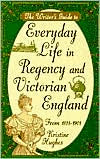 The Writer's Guide to Everyday Life in Regency and Victorian England from 1811-1901, by Kristine Hughes, 1998, Writer's Digest Books, $18.99, softbound, 248 pages. Category/Genre: reference. Cover: interesting, though the colours are a bit lacking. Where we got it: bought it. Where you can get it: Amazon, Barnes and Noble, Books-A-Million.
A must-have for any writer looking for a reference book on England in this time period. The book is quite thorough; Part One, 'Everyday Life,' examines such topics as lighting, heating, and plumbing, home furnishings, domestic servants, and fashion.
Part Two, 'Government, War, and the Economy,' goes over the courts, the military, economics, banking, and the labouring classes.
Part Three, 'Society,' deals with shopping, etiquette, travel, mourning, and more.
There are a few black-and-white pieces of artwork and a number of bibliographies. In this book, you will find interesting tidbits, such as a list of major London newspapers in circulation from 1837-1850. Details such as this can really help a book along, and if you decide to write about characters during this time period, this book will surely be an asset.
If you like this one, try: The Writer's Guide to Everyday Life in the Wild West from 1840-1900, by Candy Moulton.
Collins Complete Guide to British Garden Wildlife by Paul Sterry, 2010, Collins, $22.14, softbound, 383 pages. Category/Genre: reference. Cover: excellent. Where we got it: bought it. Where you can get it: Amazon, Barnes and Noble.
A wonderful book in a wonderful series, British Garden Wildlife lets the reader in on the many secrets of gardens across the pond. Not only does this book cover the various species of animals, plants, and fungi apt to be found in a British garden, it also covers such topics as bird food and feeding, nesting and nest boxes, eggs, garden plants for birds, mammal tracks, trails, and signs, and the life cycles of butterflies and moths.
In addition to the usual birds, mammals, reptiles, insects, and spiders, this book also goes over non-insect invertebrates. And on the plant front, there are trees, shrubs, wild flowers, non-flowering plants, and water plants. One could scarcely ask for more.
Filled with rich, full colour photographs, this book is one for anyone who loves gardens.
If you like this one, try: Collins Complete Guide to British Birds, by Paul Sterry.


